How It Started
My name is Reagan Mitanda, and I am the founder of Unified Farm BLM. Three years ago, I returned to my village in Mpigi, Uganda, with one goal: build a sustainable business that could feed my community, support my family, and prove that small-scale farming is not just possible — it is profitable.
I did not grow up on a commercial farm. My parents kept a few local chickens for home consumption, but nothing that resembled a business. Like many young Ugandans, I spent time in the city working odd jobs, thinking that was the only path forward. But the city was expensive, opportunities were scarce, and I kept coming back to the same question: What do I have that I can build with?
The answer was right in front of me. My village had land, families who needed affordable protein, and a market for eggs that was always hungry. What it did not have was a reliable local supplier. Every egg in the local market came from distant farms or commercial distributors, driving prices up and freshness down. I saw an opening.
I started with 20 local chickens and UGX 80,000 (about $22). I did not have a big barn, fancy equipment, or formal agricultural training. What I had was a willingness to learn, a habit of reading everything I could find about poultry farming, and the stubborn belief that consistency beats perfection.
Those first six months were brutal. I lost nearly half my flock to Newcastle Disease because I did not know about vaccination schedules. I built a coop from scrap wood that leaked during the rainy season and nearly drowned my birds. I overpaid for feed because I did not understand nutrition ratios. I sold eggs to neighbours for too little because I was afraid to ask for what they were worth.
But every failure taught me something irreplaceable. That Newcastle outbreak taught me that prevention is non-negotiable. The leaking coop taught me that housing is an investment, not an expense. The bad feed deals taught me to build direct relationships with suppliers. The low pricing taught me that confidence in your product matters as much as the product itself.
By month eight, I had rebuilt my flock with vaccinated birds. By month twelve, I was producing enough eggs to sell at two local markets. By month eighteen, other farmers in Mpigi were coming to me for advice. And by year two, I realised this was not just a business — it was a model that could be replicated by anyone with a small plot of land and a little patience.
What I Learned Early
"You don't need to be perfect to start. You need to start to become perfect. Every successful farmer I know started with dead birds, bad coops, and empty wallets. The difference is they kept going."
— Reagan Mitanda, Founder
Where We Are Today
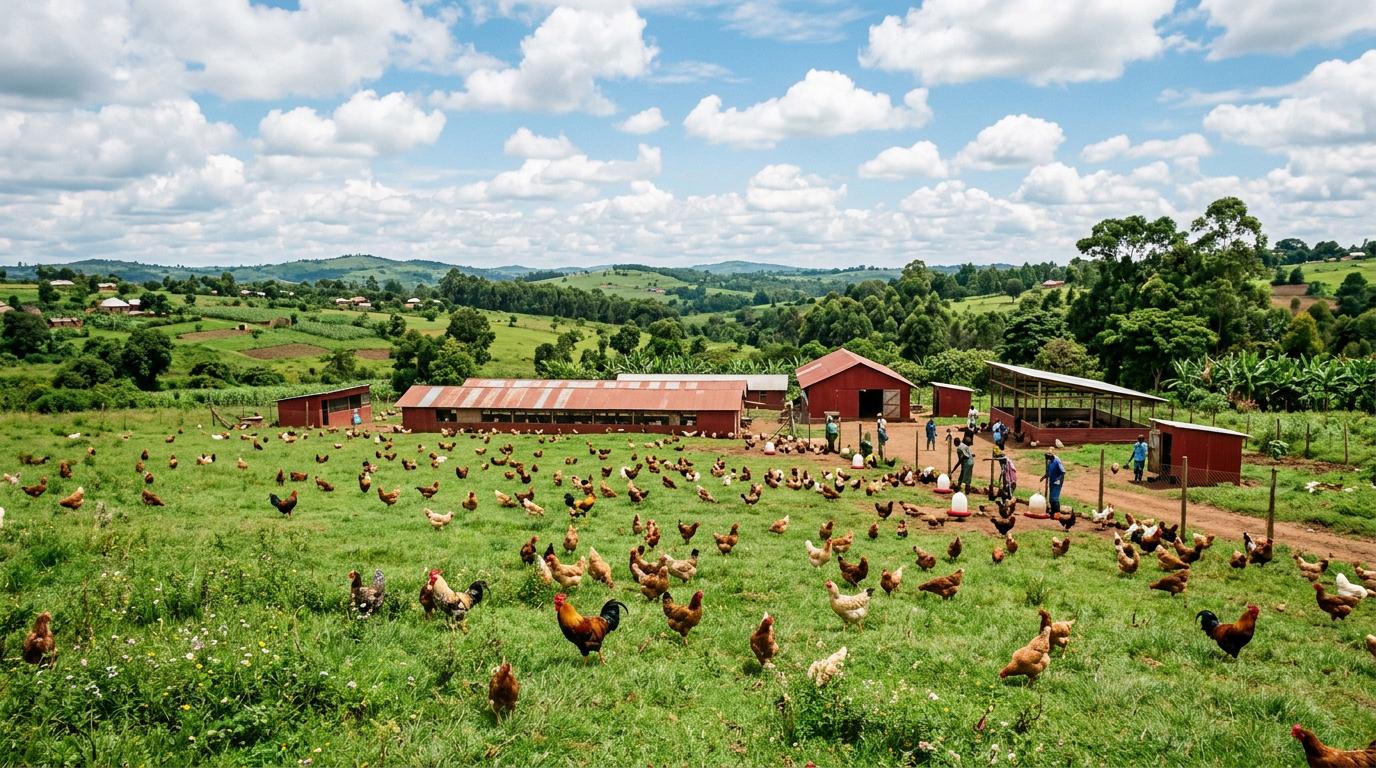
Today, Unified Farm BLM produces over 500 fresh organic eggs daily and maintains a flock of more than 300 birds across layers, breeders, and broilers. We have supplied day-old chicks and brooded chicks to over 50 farmers across Mpigi district and beyond, from first-time backyard farmers to small-scale operations expanding their flocks.
Our farm has grown from a backyard experiment to a family-run operation that creates local jobs, supports village markets, and proves that sustainable agriculture is possible on any scale. We are not a commercial mega-farm. We are a working example of what a focused small farmer can build in Uganda — one egg, one chick, and one farmer at a time.
Our expertise areas:
- Breeding and incubation: We maintain a consistent 85% hatch rate using both natural brooding and artificial incubation methods. Our incubation guide is one of the most-read resources on our blog.
- Vaccination and biosecurity: We follow a strict vaccination schedule for Newcastle Disease, Gumboro (IBD), Fowl Pox, and Marek's Disease. Our biosecurity protocols have kept our flock disease-free for over two years.
- Nutrition and feed management: We formulate feed ratios that reduce costs while maximising egg production, and we teach other farmers how to do the same using locally available ingredients.
- Market access and pricing: We have built direct relationships with local restaurants, schools, and household buyers in Mpigi, bypassing middlemen and keeping prices fair for both sides.
- Farmer training and mentorship: We regularly host visiting farmers and share what we have learned through our blog, WhatsApp groups, and one-on-one consultations.
Why We Do This
I chose poultry farming because it is one of the most accessible agricultural businesses in the world. Unlike crops that need seasons, land, and perfect weather, chickens produce eggs daily and meat in weeks. A family can start with five hens and grow from there.
But our mission goes beyond profit. Every time we sell a tray of eggs, supply a farmer with healthy chicks, or teach a beginner how to build a coop, we're investing in our community. We're proving that you don't need to leave the village to succeed. You can build something right where you are.
What We Believe
🌱 Start Small, Learn Fast
You don't need 1,000 birds to be a farmer. Start with five. Learn the daily routine. Make mistakes. Then grow. Every big farm started as someone's first attempt.
💉 Health Before Profit
We vaccinate every bird. We clean every coop. We never cut corners on health because sick birds don't produce, and dead birds don't come back. Prevention is cheaper than cure.
🤝 Community Over Competition
We share what we know. When another farmer in Mpigi succeeds, we all benefit. The demand for eggs in Uganda is bigger than any single farm can meet.
🎯 Quality Over Quantity
We'd rather sell 100 perfect eggs than 200 mediocre ones. Our reputation is built on every tray we deliver. One bad batch can undo years of trust.
What Farmers Say About Us
We do not just sell eggs and chicks. We build relationships. Here is what some of the farmers we have worked with have shared about their experience with Unified Farm BLM.
"I bought 50 day-old chicks from Reagan in 2024. He did not just hand me a box and leave. He walked me through the brooding setup, sent me a vaccination schedule, and checked on me by WhatsApp for the first three weeks. Today those 50 chicks are laying hens that feed my family and pay my children's school fees."
— Sarah Nakato, Mpigi
"I was ready to quit poultry after losing my entire flock to Gumboro. Reagan explained what I had done wrong, helped me disinfect my coop properly, and sold me vaccinated chicks at a price I could afford. His blog articles on vaccination timing saved my second attempt."
— David Ouma, Wakiso District
"As a restaurant owner in Mpigi town, I need fresh eggs every morning. Reagan delivers consistently — same size, same quality, same time. His eggs stay fresh longer than the ones I used to buy from Kampala, and his prices are fair because there is no middleman."
— Grace Namuli, Restaurant Owner
Why Trust Our Advice
Everything we share on this blog and website comes from direct, hands-on experience. We do not write about theories we read in books. We write about what we have done, what failed, what worked, and what we learned in the process.
- Real experience: Every vaccination schedule, feeding ratio, and hatching technique described here is something we have tested on our own farm.
- Local context: We farm in the same conditions as our readers. We deal with the same feed shortages, the same rainy seasons, the same market fluctuations, and the same veterinary challenges.
- Continuous learning: We attend local agricultural workshops, consult with veterinary officers in Mpigi, and stay connected with poultry farmer networks across Uganda to keep our knowledge current.
- Transparency: When we recommend a product, a supplier, or a technique, we tell you exactly why and what our own results have been. We do not promote anything we have not tested.
- Community accountability: Our reputation in Mpigi depends on the advice we give. If we steer a farmer wrong, word travels fast. That keeps us honest and careful.
Looking Forward
Our goal for the next three years is to:
- Expand our flock to produce 2,000 eggs daily
- Launch a formal training program for new farmers in Mpigi district
- Build a community processing center for egg cleaning and packaging
- Connect with more restaurants, schools, and hospitals in the region
- Prove that a farm started with $50 can become a $500/month business
Whether you're a beginner looking to start your first flock, a restaurant needing fresh eggs, or an experienced farmer wanting to connect, we want to hear from you. Farming is better together.